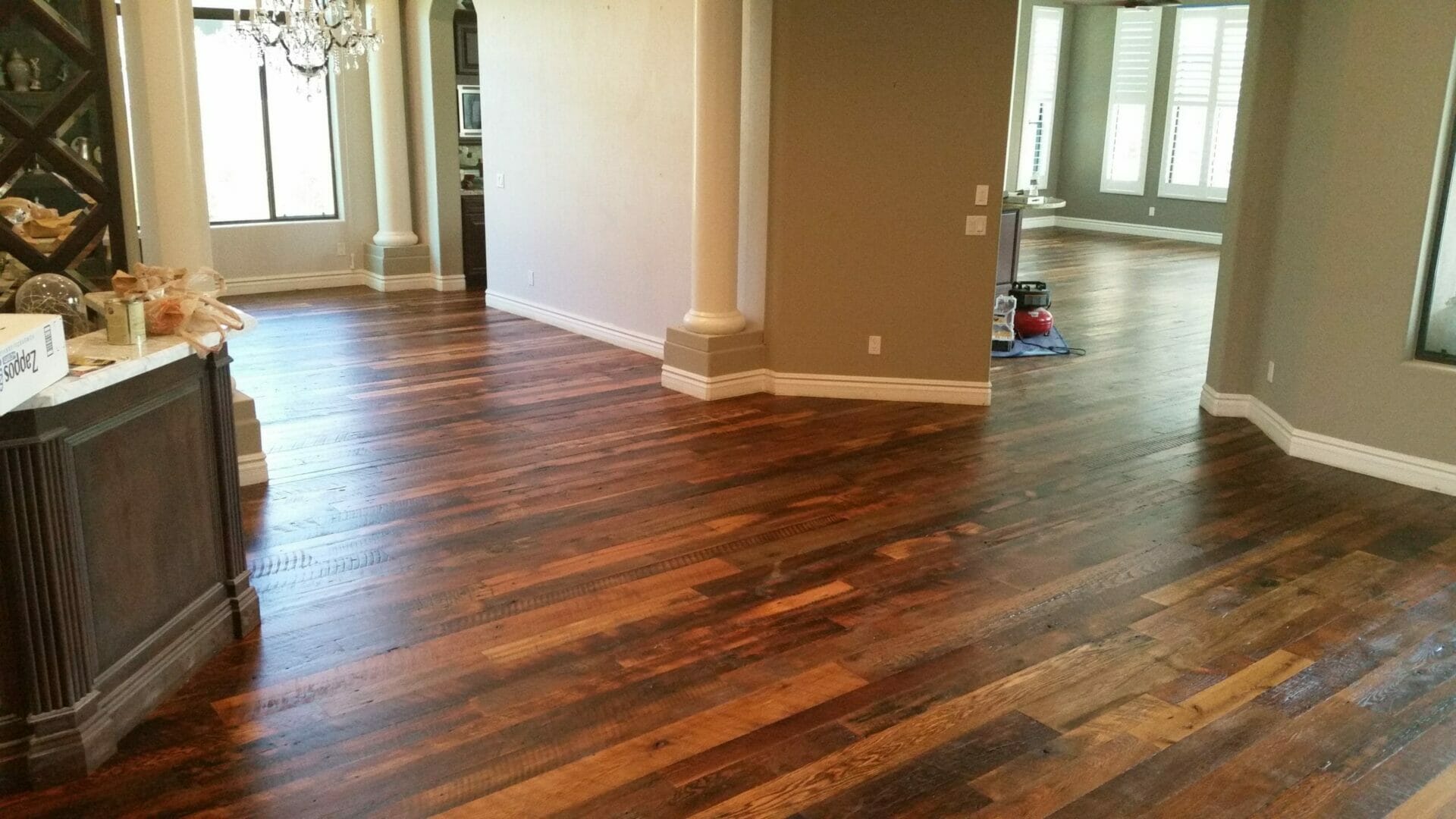
When homeowners picture their dream hardwood floors, they usually focus on the surface: the rich oak grain, the deep stain tone, or the sleek matte finish. But as the owner of Mystique Hardwood Floors, I’ll tell you a secret that every master craftsman knows:
Your finished hardwood floor is only ever as good as the subfloor beneath it.
You can buy the highest-grade solid wood or premium engineered planks on the market, but if they are installed over an uneven, unflattened subfloor, the installation is compromised from day one. Here is why subfloor prep—specifically grinding down high spots and filling in low spots—is the most crucial step of any hardwood flooring project.
What Happens When You Skip Subfloor Prep?
Subfloors (whether concrete slabs or plywood) are rarely flat out of the box. Concrete slabs develop humps and dips as they cure, while wooden subfloors can warp, sag, or develop ridge seams over time.
If hardwood is laid over an uneven surface without correction, several long-term problems occur:
- Hollow Sounds & Vertical Movement: Dips in the subfloor leave empty pockets underneath glued or floating planks. Every time you step on these areas, the wood flexes down, creating an annoying hollow sound or noticeable springiness.
- Squeaking & Popping: In nail-down installations, continuous flexing pulls nails or cleats loose from the subfloor, leading to persistent squeaks.
- Board Separation & Buckling: High spots act as fulcrums. As planks ride over a hump, pressure points form, forcing tongue-and-groove joints to strain, crack, or gap over time.
- Premature Finish Wear: Uneven boards sit at slightly different heights (known as lippage). The raised edges catch foot traffic, vacuum heads, and furniture legs, wearing out the top protective finish prematurely.
The Standard for Flatness: Industry Benchmarks
In the flooring industry, “flat” has an exact mathematical definition set by the National Wood Flooring Association (NWFA).
| Installation Type | NWFA Flatness Tolerance Standard |
|---|---|
| Nail-Down Hardwood | Maximum variation of 1/4″ in 10 feet (or 1/8″ in 6 feet) |
| Glue-Down & Floating Hardwood | Maximum variation of 3/16″ in 10 feet (or 1/8″ in 6 feet) |
How Mystique Hardwood Floors Preps a Subfloor
Flattening a subfloor isn’t about making it perfectly level relative to the horizon—it’s about making it perfectly flat so the wood rests uniformly across the entire surface. This requires a two-pronged mechanical approach:
1. Grinding High Spots (Taming the Humps)
High spots on concrete slabs are mechanically ground down using heavy-duty diamond-head concrete grinders equipped with HEPA dust-extraction systems. On plywood subfloors, high seams and ridges are leveled using heavy-grit mechanical sanders to create a smooth transition across joists.
2. Filling Low Spots (Eliminating the Dips)
Low areas require filling to create a level plane. For concrete, we apply high-strength, cementitious self-leveling compounds or fortified patching compounds after applying a specialized bonding primer. For wooden subfloors, low spots are carefully shimmed or patched with engineered subfloor levelers designed not to crack under flex.
Long-Term Benefits of Proper Subfloor Leveling
- Flawless Aesthetics: Planks lie completely flush, giving your home that smooth, seamless, high-end look.
- Quiet Acoustic Performance: Eliminates hollow reverberations and friction-induced squeaks.
- Valid Manufacturer Warranties: Virtually all major hardwood manufacturers specify NWFA subfloor flatness requirements in their warranty terms. Proper prep protects your investment.
- Maximized Lifespan: Eliminates uneven stress points, allowing your floors to expand and contract naturally for decades.
Frequently Asked Questions About Subfloor Prep
Can underlayment pad hide an uneven subfloor?
No. Foam or felt underlayment provides moisture protection and sound attenuation, but it compresses under weight. It cannot compensate for structural dips or high spots exceeding 1/8 inch.
Is subfloor grinding and leveling necessary for both solid and engineered hardwood?
Yes. While engineered hardwood handles minor humidity fluctuations better than solid wood, both floor types require a flat foundation to maintain structural joint integrity and prevent hollow spots.
How long does subfloor leveling take to dry?
Depending on the depth of the dip and the product used, self-leveling compounds typically cure within 4 to 24 hours before hardwood installation can safely proceed.
